|
HDG Coating
Galvanizing forms a metallurgical bond between the zinc and the
underlying steel or iron, creating a barrier that is part of the
metal itself. During galvanizing, the molten zinc reacts with the
surface of the steel or iron article to form a series of zinc/iron
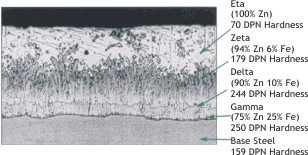
alloy layers. The figure below is a photomicrograph of a galvanized
steel coating cross-section and shows a typical coating
microstructure consisting of three alloy layers and a layer of pure
metallic zinc.
Galvanizing forms a metallurgical bond between the zinc and the
underlying steel or iron, creating a barrier that is part of the
metal itself. During galvanizing, the molten zinc reacts with the
surface of the steel or iron article to form a series of zinc/iron
alloy layers. The figure below is a photomicrograph of a galvanized
steel coating cross-section and shows a typical coating
microstructure consisting of three alloy layers and a layer of pure
metallic zinc.
Progressing from the underlying steel surface outward, these are:
 |
The thin Gamma layer composed of an alloy that is
75% zinc and 25% iron. |
|
|
The Delta layer composed of an alloy that is 90%
zinc and 10% iron. |
|
|
The Zeta layer composed of an alloy that is 94% zinc
and 6% iron. |
|
|
The outer Eta layer that is composed of pure zinc.
|
|
 |
|
To learn more about the
hot-dip galvanized coating, select one of the categories
below: |
|
|
Bond Strength |
|
|
Coating Uniformity |
|
|
Coating Thickness
|
|
|
Bond Strength:
Below the name of each layer in the figure above
(magnified cross-section of hot-dip galvanized coating)
appears its respective hardness, expressed by a Diamond
Pyramid Number (DPN). The DPN is a progressive measure
of hardness; the higher the number, the greater the
hardness. Typically, the Gamma, Delta and Zeta layers
are harder than the underlying steel. The hardness of
these inner layers provides exceptional protection
against coating damage by abrasion. The Eta layer is
quite ductile, providing the coating with Resistance.
The galvanized coating is adherent to the underlying
steel on the order of several thousand pounds per square
inch (psi). Other coatings typically offer adhesion
rated at several hundred psi at best. Hardness,
ductility and adherence combine to provide the
galvanized coating with unmatched protection against
damage caused by rough handling during transportation to
and/or at the job site, as well as in service. The
toughness of the galvanized coating is extremely
important since barrier protection is dependent upon the
integrity of the coating.
|
|
Coating Uniformity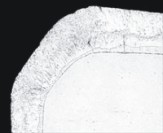
The galvanizing process naturally produces coatings that
are at least as thick at the corners and edges as the
coating on the rest of the article. As coating damage is
most likely to occur at the edges, this is where added
protection is needed most. Brush- or spray-applied
coatings have a natural tendency to thin at the corners
and edges. The figure below is a photomicrograph showing
a cross-section of a corner of a galvanized piece of
steel.
Because the galvanizing process involves total immersion
of the materi-al, all surfaces are coated. Galvanizing
provides protection on both exterior and interior
surfaces of hollow structures. Hollow structures that
are painted (but not galvanized) have no corrosion
protection on the inside.
The inspection process for galvanized items is simple
and fast and requires minimal labor. This is important
because the inspection process required to assure the
quality of many brush- and spray-applied coatings is
highly labor-intensive and uses expensive skilled labor.
Galvanizing takes place in a factory regardless of
weather or humidity conditions. Most brush- and
spray-applied coatings depend upon proper weather and
humidity conditions for correct application. This
dependence on atmospheric conditions often translates
into costly construction delays. The galvanizer’s
ability to work in any type of weather allows a higher
degree of assurance of on-time delivery. Working under
these circumstances, galvanizing can be completed
quickly and with short lead times. A turnaround time of
two or three days for galvanizing is common.
|
|
 Coating
Thickness Coating
Thickness
The American Society of Testing and Materials
International (ASTM), the Canadian Specification
Association (CSA) and the American Association of State
Highway and Transportation Officials (AASHTO)
specifications establish minimum standards for thickness
of galvanized coatings on various categories of items.
These minimum standards are routinely exceeded by
galvanizers due to the nature of the galvanizing
process.
Factors influencing the thickness and appearance of the
galvanized coating include chemical composition of the
steel, steel surface condition, cold-working of steel
prior to galvanizing, bath temperature, bath immersion
time, bath withdrawal rate, and steel cooling rate.
The chemical composition of the steel being galvanized
is very important. The amount of silicon and phosphorus
in the steel strongly influences the thickness and
appearance of the galvanized coating. Silicon,
phosphorous or combinations of the two elements can
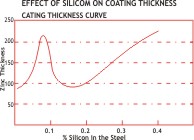
cause thick, brittle galvanized coatings. The coating
thickness curve shown in the figure below relates the
effect of silicon in the base steel to the thickness of
the zinc coating. The carbon, sulfur and manganese
content of the steel also may have a minor effect on the
galvanized coating thickness.
The combination of elements mentioned above, known as
“reactive steel” in the galvanizing industry, tends to
accelerate the growth of zinc-iron alloy layers. This
may result in a finished galvanized coating consisting
entirely of zinc-iron alloy. Instead of a shiny
appearance, the galvanized coating will have a dark
gray, matte finish. This dark gray, matte coating will
provide as much corrosion protection as a galvanized
coating having a bright appearance.
It is difficult to provide
precise guidance in the area of steel selection without
qualifying all of the grades of steel commercially
available. The guidelines discussed below usually result
in the selection of steels that provide good galvanized
coatings.
|
 |
Levels of carbon
less than 0.25%, phosphorus less than 0.04%, or
manganese less than 1.35% are beneficial. |
|
|
Silicon levels less
than 0.04 % or between 0.15% and 0.25% are
desirable.
|
|
|
 Even
though it is not a part of the controlled composition of
the steel, silicon may be present in many steels
commonly galvanized. This occurs primarily because
silicon is used in the deoxidization process in steel
making and is found in continuously cast steel. The
phosphorus content should never be greater than 0.04%
for steel that is intended for galvanizing. Phosphorus
acts as a catalyst during galvanizing, resulting in
rapid growth of the zinc-iron alloy layers. This growth
is virtually uncontrollable during the galvanizing
process. Even
though it is not a part of the controlled composition of
the steel, silicon may be present in many steels
commonly galvanized. This occurs primarily because
silicon is used in the deoxidization process in steel
making and is found in continuously cast steel. The
phosphorus content should never be greater than 0.04%
for steel that is intended for galvanizing. Phosphorus
acts as a catalyst during galvanizing, resulting in
rapid growth of the zinc-iron alloy layers. This growth
is virtually uncontrollable during the galvanizing
process.
As the galvanizing reaction is a diffusion process,
higher zinc bath temperatures and longer immersion times
generally will produce somewhat heavier alloy layers.
Like all diffusion processes, the reaction proceeds
rapidly at first and then slows as layers grow and
become thicker. However, continued immersion beyond a
certain time will have little effect on further coating
growth. When galvanizing reactive steels, the diffusion
process proceeds at a faster rate, producing thicker
coatings.
The thickness of the outer pure zinc layer is largely
dependent upon the rate of withdrawal from the zinc
bath. A rapid rate of withdrawal causes an article to
carry out more zinc and generally results in a thicker
coating.
ASTM, CSA and AASHTO specifications and inspection
standards for galvanizing recognize that variations
occur in both coating thickness and compositions.
Thickness specifications are stated in average terms.
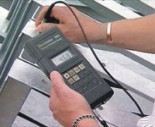
Further, coating thickness measurements must be taken at
several points on each inspected article to comply with
ASTM A 123/A 123M for structural steel and A 153/A 153M
for hardware.
|
|